Showing posts with label Tips to buy a home. Show all posts

Sep 1, 2011

A Benefit You Don't Want to Miss: DC Tax Abatement

Regular readers of our blog will know that when it comes to buying any home, you don't just pay for the house itself.

When you buy a home, there are a number of fees you will have to pay, including a fee for the appraisal, fees for the title preparation, fees for the inspection, and more.  These are called "closing costs." Luckily, if you decide to buy a home with City First Homes, our financing can help cover some of those costs.

Among your closing costs, you should also include the DC Recordation Tax.  In Washington, DC, when a homebuyer purchases a home, they usually have to pay 1.1% of the home price as a tax to the DC  Government for the new deed to be recorded in the land records.  In parallel, the seller usually covers the Transfer Tax, also 1.1% of the home price, which is a tax on transferring real property.

However, for qualified purchasers - purchasers who are lower-income or who are purchasing in an "economic development" zone - you may be eligible for the DC Tax Abatement.  If you qualify, not only do you NOT have to pay the 1.1% Recordation Tax; but the seller's 1.1% Transfer Tax amount is credited to you!  What a great deal!

To learn more and see if you qualify, visit http://otr.cfo.dc.gov/otr/cwp/view,a,1330,q,594233.asp


- Jyothi Ramakrishnan

Aug 22, 2011

What Can Be Done for "Underwater" Homeowners?

In the pages of today's New York Times, an editorial suggests that far, far more needs to be done for homeowners who are "underwater."  Underwater is a term referring to a homeowner who owes more on their home than the home is currently worth.


It is an old truism, and quite possibly true, that where the housing market goes, so goes the economy. In other words, as the article states, "Congress and the White House have yet to figure out that the economy will not recover until housing recovers."  Essentially, we're all in this together!


So what can be done? Banks were offering homebuyers tricky "subprime" mortgage loans whose interest rates suddenly jumped up after several years. Programs like City First Homes are a large part of the solution.  CFHomes, in contrast, helps homebuyers to affordably access homeownership with fixed-rate financing, and offers buyers homebuyer education classes prior to purchase.


The editorial states:
  • Banks are not doing enough: "Instead of pushing the banks to do what is needed, the Obama administration has basically urged them to do their best to help, mainly by reducing interest rates for troubled borrowers. The banks haven’t done nearly enough. In many instances, they can make more from fees and charges on defaulted loans than on modifications." 
  • Fannie Mae and Freddie Mac can force banks to do more: "[The government should] start by working with Fannie Mae and Freddie Mac, the government-run mortgage companies, to aggressively reduce the principal balances on underwater loans and to make refinancing easier for underwater borrowers."
This article offers one perspective on what could be done; other articles have suggested alternative solutions.  The main point is that something has to be done, if the housing market -- and eventually the economy -- are going to recover.  We're all in this together!

- Jyothi Ramakrishnan

Jul 5, 2011

74% of Homebuyers Can Use CFHomes as a Ladder!

People are different: some people will use City First Homes (CFHomes) to buy a home to live in for generations. In contrast, others may use the program as a "ladder" to traditional homeownership (Although no type of homeownership is really "traditional," we are referring to homeownership where you don't have to share appreciation).  How can CFHomes be their ladder? Well, instead of renting, they live in a CFHome for 5 to 7 years, building up wealth so they can pay the down payment for a traditional home!

74% is the key number.  A recent study was conducted with the Champlain Housing Trust, the nation's largest shared-appreciation housing trust, whose model is similar to CFHomes'.  They followed buyers for 20 years and found:

Among the [Champlain Housing Trust] homeowners whose subsequent housing situations were known, 74% of them bought [traditional] homes within six months of re-selling their limited-equity houses or condominiums; another 5% traded their first resale-restricted home for another, choosing to remain within the [Champlain Housing Trust]. The rest may have returned to renting or other outcomes.

It's also important to note that the average amount of time a Champlain Housing Trust owner lived in their home was only 5 years!  So it did not take them decades to save up to buy a traditional home; it was a relatively short amount of time.

So if you're thinking about homeownership but worried about the costs, why rent when you can use CFHomes as YOUR ladder?  You'll build wealth for the future, get to "practice" being a homeowner, and enjoy the stability and tax benefits of owning a home!

To read the full study, please click here.

Jun 20, 2011

Interest Rates Rise for the First Time in 8 Weeks

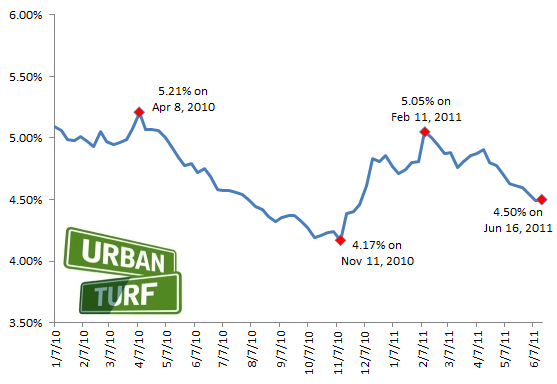
According to UrbanTurf, long-term mortgage rates had been dropping for eight straight weeks by the end of last week, but the interest rates for 30-year fixed mortgages are starting to go up. The good news is overall mortgage rates are still at their lowest point since last December.

If you have been looking at the market for a while, now may be a great time to talk to your lender to find out how you can benefit from the current historically low interest rates.

Layer the City First Homes program with conventional loans and you are even one step closer to your new home!


image  


(Graph from UrbanTurf website)

- Anlan Zhang

Jun 15, 2011

Live Near Your Work! Grants to Support Homeownership - Deadline Coming Up!

While CFHomes supports anyone who wants to buy a home in DC, we want to highlight a special opportunity for DC Government employees! Do you work for the DC Government? Do you live far from your work but you want to move closer?

Tell your employer about the Washington, D.C. Office of Planning's Live Near Your Work (LNYW) pilot program!

The program offers matching grants up to $6,000 for down payment and closing cost assistance. The point is to encourage individuals to move within two miles of their work, within a half-mile of a Metro station, or within a quarter-mile of a “high quality” bus corridor.

If you work for the DC Government, ask your employer to apply today!! Right now, the Office of Planning is accepting applications from employers to "administer" the loans to their employees.  While the first deadline is almost here (June 17, 2011), they will be accepting more applications until October if they cannot find qualified employers.

Learn more! http://thecityfix.com/?p=12927 or http://planning.dc.gov/DC/Planning/About+Planning


- Sara Giordano


Jun 13, 2011

City First Homes' work is mentioned on NewsTalk with Bruce DePuyt!

CFHomes' work on preserving the city's first African-American-founded cooperative was mentioned on TBD News Talk recently!  View the following interview with CFHomes' Board Member and Enterprise Community Partners VP and Market Leader, David Bowers - click here!

The mention of CFHomes' work starts at 25:15.


- Sara Giordano

If you're a government employee, this housing opportunity is for you!

CFHomes serves anyone who wishes to purchase a home, not just government employees. However, we like to highlight all the great programs available out there, and if you're a DC government employee, you'll want to know about:

THE NEGOTIATED EMPLOYEE AFFORDABLE HOME PURCHASE PROGRAM (NEAHP)

The Negotiated Employee Affordable Home Purchase Program (NEAHP) provides down payment and closing cost assistance to government employees whose position is covered by collective bargaining. 

It offers union employees with financial assistance through a grant, to be used toward the purchase of a primary residence in the  District of Columbia.

You can use this program in combination with CFHomes or any other DC Government housing program. 

You may be wondering who is eligible? All Government of the District of Columbia employess whose position is covered by the following collective bargaining agreements are eligible for NEAHP. This includes:

·       District of Columbia  Compensation Units 1&2;
·    Employees represented by the American Federation of State, County and Municipal   Employess, Local 2095 and the American Federation of Government Employees Local 383;
·       Service Employees International Union 1199; and
·       The district of Columbia Nurses Association.

It is also required that you:
 
·     Be a current employee of the Government of the District of Columbia in good standing;
·     Employee cannot have primary ownership interest in any residential property within the District of Columbia for three years prior to amaking application to NEAHP; and
·     Employee must possess a good credit rating.


To learn more and see how to apply, click here: http://www.gwul.org/docs/nehap_0.pdf


- Sara Giordano

Jun 6, 2011

Tired of all that "small print" that's impossible to understand? Welcome the new Consumer Financial Protection Bureau!

Ever gotten a loan - only to be disgusted by the amount of "small print" accompanying paperwork that was impossible to understood? We have too, and are huge supporters of the newly created Consumer Financial Protection Bureau. This bureau was created to force lenders to provide clear, obvious information to borrowers of loans -- so that we can avoid huge housing bubbles and crashes, like the one in 2006.  Homebuyers will definitely benefit from this.


The New Yorker explains in an awesome article today how the newly launched Consumer Financial Protection Bureau will help homebuyers!  Yet there is still resistance from some lenders.  But as the article explains:


"While some bankers accept the need for consumer protection, they maintain that the Consumer Financial Protection Bureau will go too far and end up strangling financial innovation. But, over the past century or so, new regulatory initiatives have inevitably been greeted with predictions of doom from the very businesses they eventually helped. Meatpackers hated the Meat Inspection Act of 1906, but it rescued the industry from the aftereffects of the publication of “The Jungle.” Wall Street said that the creation of the S.E.C. would demolish stock trading, but the commission helped make the U.S. the world’s most liquid and trusted stock market. And bankers thought that the F.D.I.C. would sabotage their industry, but it transformed it by effectively ending bank runs."


It's time for all lenders to provide borrowers with clear, concise information about the loans they are borrowing. You can read the full article here. 


- Jyothi Ramakrishnan

Historic Time to Buy a Home

The Wall Street journal makes the case today for why now is a historic time to buy a home. Among their key points:
  • Mortgage rates, which fell to 4.55% for the week ending June 2 are near 50-year lows. 
  • According to Moody's Analytics, the ratio of home prices to income is now 20.9% lower than the 15-year average through 2010, and 12.5% lower than the 1989-2004 average 
  • A historic glut of homes has created a buyer's market: There were about 15 million vacant homes in the U.S. last year, according to John Burns Real Estate ConsultingInc.—some 3.1 million more than normal.
You can read the full article here.

- Sara Giordano

May 31, 2011

Housing Prices Go Down in Almost All Major Cities -- But Rise in Washington, DC

According to today's New York Times, data from the respected Case-Shiller Index show that housing prices in 20 cities across the country have hit their lowest since the recession began.  However, while nearly all 20 major cities showed housing prices falling from February to March 2011, Washington, DC was among the few to show a gain of 1.2%.  It also had the largest gain in housing prices among all the cities.

In DC, housing prices are definitely lower than the peak of the housing bubble in 2006 - but seem to be hovering around the housing price levels of 2004.  DC prices also seem to be rising on an upward trend.  While it's impossible to know where housing prices will go, it might be a good time to consider home purchase in the District, before housing prices rise too much.

Check out the full article and chart here.

May 21, 2011

Mapping Washington, DC's Urban Food Deserts

"Urban food deserts" is a term that economists apply to areas and neighborhoods in cities that lack grocery stores.  All too often, urban food deserts are found in low-income neighborhoods where major grocery chains have chosen not to set up shop.  Ironically, eating out all the time is inevitably is more costly than buying and cooking groceries!

Equally as troubling, the phenomenon of urban food deserts has been pointed to as one reason for rising rates of obesity. Restaurant food on average is less healthy than what people cook themselves, since restaurant cooks will add anything - sugar, butter - to make it taste good so people will buy it!  Urban food deserts force people to eat out more, putting their health at increased risk.

When buying your home, if you don't have a car, one thing you might take into consideration is whether your neighborhood has an accessible grocery store. This can impact both your wallet and your health.  But where exactly are Washington, DC's food deserts?

The U.S. Department of Agriculture recently released a Urban Food Desert Mapping System!  Over at DCentric, they've gone ahead and mapped DC's food deserts, and here were their findings:

  • Around 18,000 DC residents live in urban food deserts
  • 13% of DC households face 'food insecurity' - they are unable to acquire nutritionally adequate food
  • In one such desert, 39% of residents are children
  • Prince George's County has more urban food deserts, but Washington, DC's deserts have higher concentrations of children
  • According to DC Hunger Solutions, only 16% of the city's full-service grocery stores are located east of the Anacostia River 
Click here to view the Washington, DC food desert map.  Troubled by this phenomenon? Check out the great work of DC Hunger Solutions, a nonprofit that addresses DC's urban food desert problem, or consider speaking with your D.C. Council Member or writing a letter to the editor of your local newspaper.  There has been some debate over at DCist whether Wal-Mart's attempts to come to DC, as strongly unpopular as it is among some DC residents, could potentially alleviate some of the city's food deserts.

May 16, 2011

How to save money by 'weatherizing' your home or apartment

Did you know that one way to save money on your energy bills is through 'weatherization'?

Weatherization refers to making sure your home or apartment is properly insulated and energy efficient, so that you do not waste unnecessary money on utility bills!  There is now an entire movement behind weatherization - the federal government provides tax credits to those who weatherize their home, and here in Washington, DC, a nonprofit called WeatherizeDC is trying to create a citizens' movement.

You may think insulating your home is a winter activity, but it's equally relevant in the summertime.  When June hits, you may end up spending more on your A/C bills than you think, if your home is not properly weatherized. Insulation not only helps keep your home toasty in the winter, but also helps keep it cool in the summer.  And weatherization is not just for homeowners -- renters will want to get in on the action too, so they can avoid high A/C bills when the sun starts roasting the District.

So how can you save money through weatherization?  We thought this article by Energy Star provided some helpful tips to insulate your home -- click here!


- Sara Giordano

May 5, 2011

What in the World is Shared Appreciation? (And Why Should I Consider It?)


Shared appreciation. It sounds like you must give up wealth-building. But have you heard the old adage, "In order to receive you must also give?" That's how we see shared appreciation. It's a huge win-win and you definitely gain more than you give. 

The long-term trend in most American cities is that housing prices are rising faster than middle-class incomes are rising. 15 years ago, it would have been easier to buy a home on U Street or the Southwest Waterfront, but now, buying a home there is a lot more expensive.


CFHomes helps to fight this pattern.  We make homeownership more affordable with a Down Payment Assistance Loan, which lowers monthly and upfront costs.  Each time the home is sold, 75% of the home's "growth in value" will be a direct grant to reduce the home price for the next, CFHomes-eligible buyer of the same property.  As a result, the home stays "permanently affordable!" But the key is, even if you are sharing appreciation, you still build significant wealth.  Let's look at the numbers: 
Buying the same $199,900 home*
 CFHomes vs. buying with FHA loan vs. buying with Conventional loan with 5% down payment


                              CFHomes          FHA          Conventional
  
Total upfront costs       $3,998          $14,254         $17,253

Total monthly costs      $1,316          $1,529            $1,536

Suppose you decide to sell after 5 years.  Assume the home has grown in value to $231,739; and you sell it for that amount.  

After paying back all mortgage loans and sharing 75% appreciation (CFHomes), the seller walks away with: 

                                 CFHomes        FHA      Conventional
                                  $7,007        $34,608       $38,506

However, you must take into account how much moreyou spent on the same home with FHA and Conventional, due to higher monthly and upfront costs:
FHA - Spend $22,197 more than CFHomes
Conventional - Spend $25,617 more than CFHomes

What is the true amount that the seller walks away with at sale, after considering how much more you spend on the same home with FHA and Conventional?

                                CFHomes        FHA      Conventional
                                   $7,007         $12,411    $12,889
Bottom Line: When you buy with FHA and Conventional, although you don't share appreciation, you will have to give up some of that money anyway through higher monthly and upfront costs.
What CFHomes can offer is homeownership at reduced monthly and upfront costs, and wealth building for your future.
*In this example, we use March 2010 interest rates, assume an individual with a 720 credit score, and assume 3% annual home price appreciation. For a detailed explanation of the numbers or to see other cost scenarios, e-mailjyothi@cfhomes.org

5 Things To Consider When Asking, "When Should I Buy a Home?"

Working at City First Homes, I've met many homebuyers who tell us there are very conflicting, contradictory messages out there!

On the one hand, some people proclaim the death of the American Dream of Homeownership, following the 2006 housing crisis.  On the other hand, we hear that due to the recession, interest rates and housing prices are at historical lows.    So where does the truth lie? While we don't have the answers, here are Five Things to Consider If You're Deciding Whether to Buy:

1. Your Credit Score: One of the key factors that determines the interest rate on your mortgage loan is your credit score.  Some homebuyers work to get "minimally acceptable" credit score, so they can qualify for a mortgage loan. But a buyer with a 720 credit score is going to get a better interest rate from a lender, than someone with a 620 credit score.  So if you're thinking about buying a home, consider doing the work needed to improve your credit score.  To fix your credit score, there are sometimes *quick* things you can do (paying off a debt) and sometimes *longer-term* things you can do (like building up a new line of credit).  Luckily for DC homebuyers, the wonderful Homebuyer Education organizations mentioned in a previous post are there to help buyers think through strategies to improve credit.

2. Mortgage Rates: Right now, mortgage rates are lower than they have been in years.  Only a few months ago, in October 2010, as reported by CBS, interest rates reached low levels not seen since the 1970s.  As a result, it may be a good time to lock in a low-interest mortgage loan.  The following graph from Mortgage-X shows trends from the past 20 years.  The red line for "30 Year FRM" (30-Year Fixed Rate Mortgage) represents the most common type of mortgage loan.

30-Year FRM, 15-Year FRM, 1-Year ARM Rates, 1992 - 2010
Source: http://mortgage-x.com/trends.htm

3. Comparing Home Prices to Rental Prices: With the economy recovering from a recession, average housing prices in the District are lower than they were at the height of the housing bubble. As a previous post discussed, it may currently be cheaper to buy a home versus rent, on average, in Washington, DC.  At the same time, it's important to keep in mind that DC still has one of the strongest housing markets nationwide.


4. Income: When deciding how much money to lend you, banks will look at your monthly income.  The more you make each month, the more "home" you can purchase. For the CFHomes program, homebuyers generally are not allowed to get a mortgage loan that is higher than 35% of their monthly income. In fact, 35% is a common maximum limit for most lenders. So make sure your income is high enough, so you can get the home price you want, and afford a neighborhood you're interested in!  Lenders can give you more information on "how much home" you can currently qualify for.

5. Savings: Buying a home can incur unexpected expenses. Unlike renting, you have to take care of all repairs that may be needed, to make sure your home maintains its value.  If you lose your job, it is harder than renting to simply sell your home. As a result, it's a good rule of thumb to make sure you have savings on hand if you choose to buy a home.

These are just some of the many factors to consider when choosing when to buy a home.

Where does CFHomes come in? At City First Homes, we feel our DC-government launched affordable housing program provides homebuyers with the opportunity to take advantage of historically low interest rates and relatively lower home prices in the District; but at the same time, the program reduces monthly and upfront costs, making homeownership more affordable.

- Jyothi Ramakrishnan

Apr 27, 2011

Spotlight on... Homebuyer Education Organizations!

Did you know: there are several DC-government supported non-profit 'housing counseling organizations' in DC, whose sole purpose is to provide homebuyers with support and assistance so they are prepared and empowered to buy a home?

Buying a home can be tricky and costly, and there are many unexpected fees and challenges.  Whether you want to learn about how to fix your credit, how to write a contract, what title company fees to expect, or understand all the affordable housing programs out there, their impressive counselors can help you navigate the tricky path to homeownership, with support that is either free or low-cost.  They serve as buyer advocates, so that DC homebuyers are empowered and educated about buying a home.

We at CFHomes are lucky to have had a chance to get to know many of the wonderful staff at these organizations.  In fact, when we've had questions about housing policy in DC, we've turned to these groups on numerous occasions to help us out!  We have tremendous respect for all of them, and we've had a chance to get to know the staff at the Latino Economic Development Corporation and Housing Counseling Services in particular, two organizations doing great things for homebuyers.

If you're curious about what these organizations do and if they can help you out, feel free to check out the full list of HUD-approved Homebuyer Counseling organizations in DC -- click here!

Apr 22, 2011

How CFHomes Helps You Avoid PMI Fees


Did you know FHA is raising its Mortgage Insurance 0.25% in April? Here's how you can avoid paying it:

FHA has long been a great loan program for buyers whose goal is to reduce their down payment. 

However, there are new prices increases on the near horizon with the FHA program.  So what's in store?

Unless you are able to put 20% down, most every bank will require you pay a monthly mortgage insurance premium, called MIP for short.  On April 18, MIP fees for FHA loans went up 0.25% on every FHA loan optionavailable. 

For example, this will increase the payment of a $325,000 mortgage by $68 per month or $816 per year. Since most FHA mortgages require a monthly MIP payment for the first five years, this could mean a few thousand dollars extra in total cost.


Making your home as easy on your budget as possible is our  major goal here at CFHomes.  If you buy a home worth $320,000 or less, CFHomes will be able to completely eliminate these fees.  For higher-cost homes, we will significantly reduce the number of years you have to pay it.  

How? Instead of borrowing one large, higher-interest mortgage loan from a bank, you replace a significant portion of it with the $75,000 CFHomes Down Payment Assistance. Your mortgage loan from a bank becomes less than 80% of the home price, and you don't have to pay the mortgage insurance fees!

Not paying these fees can translate to hundreds of dollars in savings each month. This is just one of the ways CFHomes helps to keep your monthly costs low.  Please don't hesitate to get in touch with us if you have further questions about MIP and how it impacts your home purchase.

The Scoop on Closing Costs: Good Faith Estimate and Choosing a Title Company

Did you know: When you are buying your home, all mortgage lenders are required by law to send you a Good Faith Estimate (GFE) within 3 days of your loan application.  So what exactly is the GFE?

Just like its name, the GFE seeks to provide you with a "good faith" estimate of your closing costs.  It will list things like lender fees, insurance costs, title insurance costs, and government recording fees.   Once you receive your GFE, you should feel free to contact your lender if you have any questions about any fees that you see.

One of the fees you will see will be title preparation charges. These are the fees that title companies charges in order to prepare your closing documents, prepare a title binder, and issue title insurance.

Did you know: You as the buyer have every right to select which "title company" you'd like to purchase with.  Different title companies might have different fees, and it's your right to close with whomever you would like.


- Sukwon Lee

Apr 19, 2011

12 Hidden Costs of Homeownership

Here at CFHomes, we are excited to support homeownership; yet we want to make sure all of our homebuyers know about all the costs of buying a home, so that buying a home is a great and prosperous experience for them.  I wanted to share an interesting article in US News and World Report about the 12 Hidden Costs of Homeownership.  They are:

1. Home Inspection: A home inspection helps to ensure the home is fit and habitable.  In addition, this can help the buyer determine if the home is worth buying, and potential flaws can possibly be used as leverage when negotiating the price.

2. Pest Inspection: While this may not be required, some buyers choose to pay for a pest inspection as a means to ensure your home is not riddled with termites or other insects.

3. Appraisal Fees: The home must be valued by a professional appraiser, to make sure that the price you are buying the home for is close to the actual market value of the home.


4. Closing Costs: Title companies charge fees in order to prepare, process and record your closing documents.


5. Moving Expenses: Note that buying a home includes the costs of moving!  Try to limit costs by asking family or friends to help you; or if you are relocating for a new job, see if your new employer will chip in.


6. Furniture


7. Property Taxes and Homeowners Insurance: Your monthly mortgage will include two specific costs - property taxes, charged by the local jurisdiction, and homeowner's insurance, which most lenders require.


8. Supplemental Insurance: There are supplemental types of insurance available for those interested in further protection. For example, purchasers buying in areas with high risk for flooding might consider flood insurance.


9. Condo Fees (if purchasing a condo): If you choose to purchase a condominium (in other words, a unit that is part of a larger complex of units), then you are likely to be charged condo fees to cover the expense of maintaining common areas, such as the lawn outside or the front desk.  Quick Tip: Join your condo association, so that you can have a voice when decisions are made regarding raising or lowering condo fees.


10. Utilities: As you put together your budget, don't forget to factor in your utility bills. If you are moving to a new city, find out what the typical utility costs are in that area with some internet research.  Costs can vary.


11. Ongoing maintenance: Now that you are no longer renting, you'll be responsible for all the costs and burdens of owning a home, including maintaining the lawn and cleaning out the gutter. Even to accomplish these tasks may require purchasing equipment you had not anticipated, such as snow shovels or leafblowers.


12. Repairs:  Now that you're not renting, all the sudden emergencies that pop up will have to be covered by you.  It's always smart to put aside some money in case your home needs some unexpected repairs.

For buyers who purchase with CFHomes, we will be there every step of the way to answer questions and provide clear and detailed support.  Curious to read the full article? Click here.


- Jyothi Ramakrishnan

Apr 15, 2011

DC Tax Abatement: Avoid Property Taxes for 5 Years

DC offers a great program that lets you avoid property taxes for 5 years - the Tax Abatement Program.

If you can meet the DC Tax Abatement Eligibility Criteria, then:

i) You the buyer will be exempt from real property taxes for 5 years beginning the next full tax year after filing.

ii) You the buyer will not have to pay the Recordation Tax (1.1% of the home price)

iii) You the buyer may be eligible to have the Transfer Tax, paid by the seller, credited to you! (1.1% of the home price)


                                                What are the Eligibility Criteria?

1. Property must be owner-occupied
2. Owner must meet the income level requirement
3. Property must be $320,000 in value
4. Homebuyer must be a current DC resident

Important tip: If you are interested in the DC Tax Abatement, initiate the application process as soon as you can, to make sure you qualify prior to closing.  If you go in thinking you can qualify and find out later you don't, your home purchase will unfortunately suddenly be more expensive.  Your real estate agent and title company can help you with the application process.


Click here to learn more!

- Jyothi Ramakrishnan

Apr 11, 2011

Explaining how City First Homes lowers your monthly costs [Graphic]

We at City First Homes, the DC Government-created housing trust, are excited about our program's potential to help lower the monthly costs of homeownership for DC families. We created a simple picture that shows just how the program can reduce monthly mortgage costs:


The picture assumes a mortgage rate of 5.3%, although interest rates will vary for each borrower.

Basically, instead of borrowing one mortgage loan at a higher interest rate, you can replace a significant portion of your home price with $75,000 at a below-the-market interest rate of 3.79%.

As a result, you're paying less interest each month. This translates to lower monthly mortgage costs, and therefore more of your money stays in your pocket each month.

City First Homes is a shared-appreciation program, and you share a portion of appreciation at time of sale, which goes as a grant to the next buyer to keep the home "permanently affordable."  Yet you will be paying less each month for the same home, and these savings can add up significantly over time.